How to Build a Video Wall for Gaming
Building a multi-screen video wall sounds incredible until your crosshairs vanish into a thick bezel. Here is how to pick the right panels, mounts, and GPU setup for a functional sim wall.
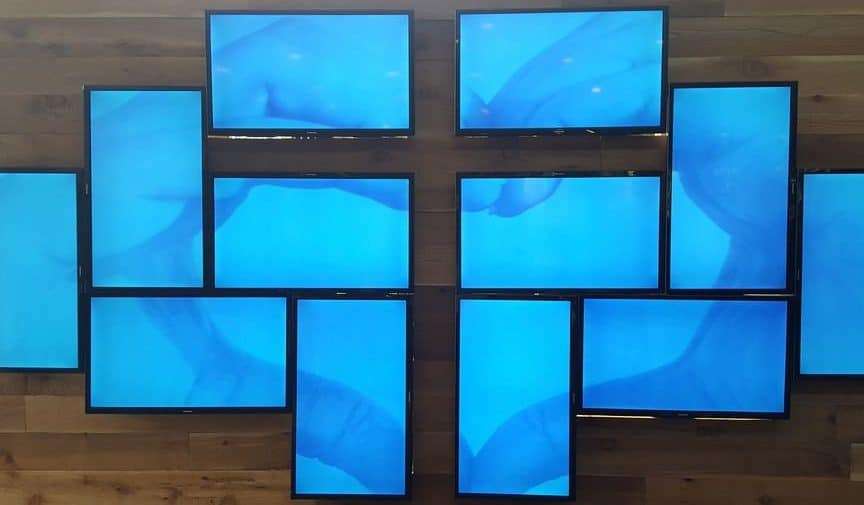
A gaming video wall makes sense for flight simulators, sim racing rigs, and command-center cockpits, but building one requires dodging severe latency and bezel traps. Before spending thousands on a 2x2 or 3x1 matrix, you need to understand how resolution scaling and panel alignment actually work in real gaming workloads.
- Best Sim Cockpit Matrix: Triple 32-inch 1440p 165Hz IPS panels with slim borders on an extruded aluminum mount.
- Best Massive Single-View Alternative: 57-inch dual-4K curved ultrawide (e.g., Samsung Odyssey Neo G9) or a 65-inch 120Hz/144Hz OLED TV.
- Best Mounting Gear: Free-standing triple/quad VESA monitor stands with micro-adjustment brackets (Sim-Lab, Next Level Racing, or Vivo).
- GPU Requirement: Nvidia GeForce RTX 4080 Super / RTX 4090 or AMD Radeon RX 7900 XTX with native multi-DisplayPort outputs.
The Hard Truth About Gaming Video Walls
Let's get straight to the point: standard commercial 2x2 video walls with cross-hair-splitting bezels are terrible for first-person shooters and action games. If your aim point rests on the intersection of four plastic borders, you will hate the setup within ten minutes. In contrast, 1x3 panoramic walls (triple-screen setups) or 2x3 high-angle instrument panels shine in titles like Microsoft Flight Simulator, iRacing, and Assetto Corsa.
If your goal is simply a gigantic, immersive picture for general gaming, we'd skip multi-panel grids entirely. A 65-inch to 77-inch 4K 144Hz OLED costs less than four decent gaming panels plus mounting hardware, uses fewer cables, and completely eliminates bezel gap. But if you need wrap-around peripheral vision or dedicated multi-instrument displays for a cockpit, a tailored monitor matrix remains unbeatable.
| Configuration | Pixel Resolution | Strengths | Weaknesses | Ideal Use Case |
|---|---|---|---|---|
| Triple 1440p (3x1) | 7680 x 1440 | Wraparound FOV, high refresh rates (165Hz+) | Wide desk footprint, side distortion | Sim racing, flight simulators |
| 2x2 Grid (4x 1080p/1440p) | 3840 x 2160 / 5120 x 2880 | Massive square canvas, towering height | Dead center bezels, heavy mounting needs | Flight cockpits, strategy games |
| 57-inch Super Ultrawide | 7680 x 2160 | Zero bezels, single cable, HDR performance | Fixed curvature, expensive ($1,600+) | Racing sims, immersive open-world |
| 65-inch 4K 144Hz OLED | 3840 x 2160 | Fastest pixel response, perfect contrast | 16:9 aspect ratio, low horizontal wrap | Console gaming, couch PC gaming |
Choosing the Right Panels and Hardware
Do not mix and match monitor models. Even slight variations in panel coatings, response times, chassis depths, and factory color calibrations will ruin the illusion of a single visual canvas. Buy identical displays manufactured in the same production batch if possible.
Key Display Requirements
Look for thin-bezel monitors with IPS or fast VA panels. Refresh rates should sit at 144Hz or higher with adaptive sync (G-Sync Compatible / FreeSync Premium). Avoid generic TV panels for multi-monitor desktop grids because consumer TVs usually lack DisplayPort, handle sleep states poorly over PC connections, and introduce varying input lag.
Mounting Hardware
Stock monitor stands are useless here. You need heavy-duty VESA mounting arms or free-standing floor rigs built from 8020 aluminum extrusion. Crucially, buy mounts with independent micro-adjustment screws for height, tilt, and rotation. If your mount lacks fine adjustment screws, aligning four or six screens flat against each other will take hours of frustrating trial and error.
How to Wire the Wall: GPU vs Hardware Controllers
How you connect the displays determines whether your input lag remains under 5 milliseconds or shoots past 60 milliseconds.
1. Direct GPU Output (Nvidia Surround / AMD Eyefinity)
This is the only method worth using for gaming. Plug each monitor directly into a separate DisplayPort output on your graphics card. You then use Nvidia Surround or AMD Eyefinity in the driver software to stitch the separate screens into one massive virtual desktop resolution. Latency penalty is zero, and variable refresh rate (VRR) generally works across identical panels.
2. Avoid Commercial Video Wall Splitters
You will see hardware video wall controllers (1-in, 4-out HDMI matrix boxes) sold online for commercial advertising. Do not buy them for gaming. These boxes take a single 4K signal, slice it, and upscale it to four outputs. They introduce heavy processing lag (30ms to 80ms), lock refresh rates to 60Hz, and disable adaptive sync. They belong in retail storefronts, not on a battle station.
Setting Up Bezel Compensation and Rigging
Once screens are physically mounted, install them with the center panel flat and the side wings angled inward between 45 and 60 degrees. For a 2x2 grid, keep the bottom row at eye level with the top row tilted slightly downward.
- Bezel Free Kits: Optical lens strips (like the Asus ROG Bezel-Free Kit) use light refraction to visually erase borders between adjacent screens. They work best on triple 27-inch and 32-inch monitors angled around 130 degrees.
- Driver Bezel Correction: Inside Nvidia Control Panel or AMD Radeon Software, run the bezel configuration utility. It hides a small strip of pixels behind the physical plastic frame so diagonal lines pass straight through the seam instead of jumping awkwardly.
- Cable Management: Route DisplayPort 1.4 or 2.1 cables with adequate slack. Cheap, out-of-spec HDMI and DP cables are the number one cause of black-screen flickering on high-resolution multi-monitor setups.
GPU Horsepower and Performance Math
Pushing a gaming video wall demands intense graphic processing power. A 3x 1440p array runs at 7680x1440 (11 million pixels), which requires roughly 33% more rendering effort than a single 4K screen (8.3 million pixels). A 2x2 array of 1440p displays runs at a staggering 5120x2880 (14.7 million pixels).
For modern titles running across three or four screens, budget for an RTX 4080 Super (16GB) as a baseline, with an RTX 4090 (24GB) or RX 7900 XTX (24GB) strongly preferred. High VRAM capacity is non-negotiable; running out of video memory across an ultra-wide rendering canvas drops frame rates to single digits instantly. Rely on modern upscalers like DLSS or FSR to maintain stable 90+ FPS in demanding simulation titles.
FAQ
Can you game on a 2x2 TV video wall?
Technically yes, but the center intersection of bezels sits directly where your aim reticle rests in most games. Unless you play flight simulators with split instrumentation or top-down strategy games, a 2x2 screen grid creates an annoying blind spot right in your primary line of sight.
Does Nvidia Surround add input lag?
No, driver-level display stitching through Nvidia Surround or AMD Eyefinity adds virtually no processing latency because the GPU renders directly to a single wide viewport. Any perceived slowdown usually comes from the increased pixel count demanding more GPU rendering time.
Can I use DisplayPort Daisy-Chaining (MST) for a multi-monitor gaming wall?
We do not recommend it. Multi-Stream Transport (MST) shares a single DisplayPort bandwidth across chained monitors. While fine for office displays at 60Hz, MST usually caps refresh rates and disables G-Sync/FreeSync when running multiple high-resolution screens simultaneously. Run dedicated cables from each monitor straight to the graphics card instead.