 ZoomPhoto 1 of 1
NVIDIA
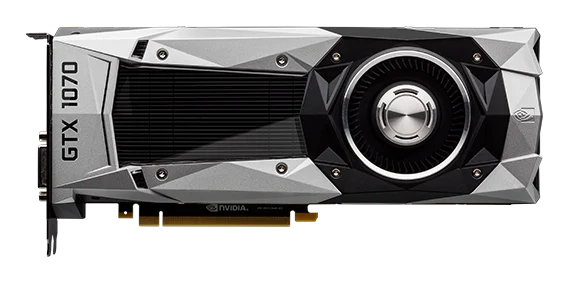
NVIDIA GeForce GTX 1070
- 3DMark Time Spy
- 6,078Bottom 25%
- VRAM
- 8 GB
- Boost clock
- 1,683 MHz
- TDP
- 150 W
Newer model: NVIDIA GeForce RTX 2070 (2018) · compare →
Previous model: NVIDIA GeForce GTX 970 (2014) · compare →
NVIDIA's second Pascal card, launched June 10, 2016 at $379 with 1,920 CUDA cores and 8GB of GDDR5 across a 256-bit bus for 256GB/s of bandwidth. Boosting to 1,683MHz at 150W, it was positioned in review testing as a $1,000 Titan X alternative for well under half the price.
Compare with
Closest equivalents from other brands (by rasterization score):
Pros
- 1,920 CUDA cores boosting to 1,683MHz, positioned in review testing as a $1,000 Titan X alternative
- 8GB of GDDR5 memory was generous for 2016-era games
- 150W TDP from a single 8-pin connector
- $379 launch price undercut NVIDIA's own Titan X by more than half
Cons
- No hardware ray tracing or Tensor cores; both arrived only with the RTX 20 series
- Founders Edition reference card cost $449, a $70 premium over the $379 partner-card MSRP
- 8GB of GDDR5 offers less bandwidth than the GTX 1080's GDDR5X (256GB/s vs 320GB/s)
Below average
#95 of 124 graphics cards#42 of 66 graphics cards under $500Computed from specs & benchmarks via our public methodology.
NVIDIA GeForce GTX 1070 benchmarks
Published results for the NVIDIA GeForce GTX 1070, next to its closest rivals and its predecessor
3DMark Time Spy
- NVIDIA GeForce RTX 2070 vs 9,073
- NVIDIA GeForce GTX 1080 vs 7,566
- NVIDIA GeForce GTX 10706,078 Bottom 25%
- AMD Radeon RX 480 vs 4,138
- AMD Radeon RX 570 4GB vs 3,852
- AMD Radeon RX 470 vs 3,680
- NVIDIA GeForce GTX 970 vs 3,645
Published 3DMark results (Wild Life Extreme for chips, the Time Spy Graphics score for graphics cards): review runs where we found them, otherwise typical published figures.
PassMark G3D
- NVIDIA GeForce RTX 207016,052
- NVIDIA GeForce GTX 108015,607
- NVIDIA GeForce GTX 107013,510 Bottom 30%
- NVIDIA GeForce GTX 9709,637
- AMD Radeon RX 4808,525
PassMark's published G3D Mark for the graphics card.
NVIDIA GeForce GTX 1070 vs NVIDIA GeForce GTX 970: what changed
The biggest differences from the NVIDIA GeForce GTX 970, the previous generation, in our spec and benchmark data.
| Spec | NVIDIA GeForce GTX 970 | NVIDIA GeForce GTX 1070 |
|---|---|---|
| 3DMark Time Spy | 3,645 | 6,078 |
| PassMark G3D | 9,637 | 13,510 |
| VRAM | 4 GB | 8 GB |
| Process | 28 nm | 16 nm |
| Base clock | 1,050 MHz | 1,506 MHz |
| Boost clock | 1,178 MHz | 1,683 MHz |
Full comparison: NVIDIA GeForce GTX 1070 vs NVIDIA GeForce GTX 970 →
NVIDIA GeForce GTX 1070 specs
Everything we track for the NVIDIA GeForce GTX 1070
General
- Announced
- 2016
- Architecture
- Pascal
- Process
- 16 nm
- TDP
- 150 W
- Power connector
- 1x 8-pin
Cores & Clocks
- Shading units
- 1,920
- Base clock
- 1,506 MHz
- Boost clock
- 1,683 MHz
Memory
- VRAM
- 8 GB
- VRAM type
- GDDR5
- Bus width
- 256 bit
- Bandwidth
- 256 GB/s
Benchmarks
- 3DMark Time Spy
- 6,078Bottom 25%#94 of 124
- PassMark G3D
- 13,510Bottom 30%
Page last updated Oct 11, 2026.
NVIDIA GeForce GTX 1070 FAQ
Is the NVIDIA GeForce GTX 1070 good in 2026?
The NVIDIA GeForce GTX 1070 earns an Inno Score of 36.4/100 (“Below average”), #95 of 124 graphics cards. Its successor, the NVIDIA GeForce RTX 2070, came out in 2018 and scores 41.0. NVIDIA's second Pascal card, launched June 10, 2016 at $379 with 1,920 CUDA cores and 8GB of GDDR5 across a 256-bit bus for 256GB/s of bandwidth. Boosting to 1,683MHz at 150W, it was positioned in review testing as a $1,000 Titan X alternative for well under half the price.
What are the key specs of the NVIDIA GeForce GTX 1070?
VRAM: 8 GB · Boost clock: 1,683 MHz · TDP: 150 W · 3DMark Time Spy: 6,078
What are the closest alternatives to the NVIDIA GeForce GTX 1070?
Its closest rivals on InnoReviews are NVIDIA GeForce GTX 970, NVIDIA GeForce RTX 2070, NVIDIA GeForce GTX 1080 — open the comparison pages for a spec-by-spec breakdown.
Use this on your site or forum
Copy a ready-made link. Scores on this page update as new results are published, so the link always leads to the current figures.